
Consider ENP Trim Ball Valve where 316 trim is specified
May 10th, 2017 by Amanda Schumann
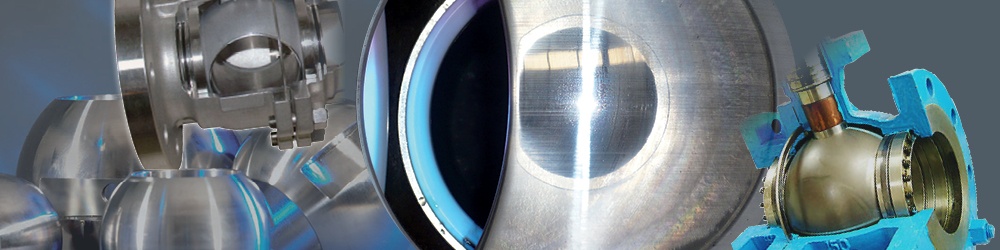
Global Supply Line stocks ENP trim trunnion on ball valves 75µm thick with 500 minimum HB (up to 900 HV) with 10-14% phosphorus, which is actually superior to 316SS. Hard ENP has excellent abrasion & corrosion resistance and is harder than 316. The superior smoothness of ENP compared to 316 also reduces torque & packing degradation and prevents ingress and entrapment of particulates further preventing erosion, abrasion & corrosion and also ensures fugitive emission compliance.
In floating ball valves “316 trim” has always been the standard because under 150mm there is only a minimal cost advantage using ENP trim in 150/300 class as the ball wall thickness is not large and the balls are mass produced keeping the costs down. However, in the trunnion mounted arena 316 trim is utilised for customer’s believing this will have a higher corrosion resistance. The first problem with this is, it’s a lot more expensive, especially in larger heavier trunnion mounted ball valves. CF8M ball is often used in lieu of 316 but it’s strength and smoothness is inferior to 316. (Even in cast trunnions, more reputable brands like APV use forged 316 balls with higher tensile stems). In higher classes and larger sizes, 316 trim materials are not strong enough and have to be substituted with F51 etc., again increasing the cost by another 30 percent. Also, from a corrosion point of view if you had a service that would corrode an ENP ball it would also corrode the carbon steel seat pockets and body component of the stem area of carbon steel body valves (of course some customers do specify seat pocket and stem overlays such as incoloy). The history of 316 trim dates back to when the standard trim was “chrome plated” which was inferior to today’s modern ENP plating. Also when a valve was removed from service and left in a corrosive salt water environment, chrome plating peeled off which could then allow rusting underneath the plating meaning the ball had to be replaced rather than being re-machined, such as with a 316 ball. Today, few valves are reconditioned under 250mm in size and with the advent of modern ENP plating this has become the new standard throughout much of Australia even for NACE service. Stockists like Global Supply Line order ENP trim in much larger quantities and the price is far more competitive. Also, reputable manufacturers like APV, Guide Valve, JC & Starline pair A105+ENP ball with 4140+ENP or 410 SS stem and/or seats, especially in larger sizes & higher classes. If you order a 316 trim valve this also means the stem, trunnion and seat holders need to be 316. Once again in higher pressure classes, 316 isn’t strong enough and then has to be substituted for even more expensive 17-4PH or F51/S31803 or XM-19 Nitronic 50, etc., increasing the costs further again.
GSL stock trunnion ball valves with A105 or LF2 or F52 + ENP .003” (76 micron) ball/trunnion. APV, Guide Valve, JC & Starline use high phosphorous EN plating that has a Vickers hardness of 500 minimum as standard (Guide Valve ENP as standard is ≥ 900 HV [66.5 HRC]). 316 Stainless steel is very soft and has no minimum ASTM hardness level. An .003” EN plated ball resists scratches much easier than 316SS. Also it is smoother and provides a better seal in higher classes. A105/ LF2/ F52 + ENP is also stronger for higher pressure service compared to 316. Where 316 trim is specified in higher classes, it needs to be substituted with F51 further ramping up the price. When paired with PEEK high pressure seats, 316 or F51 needs to be ENP plated anyway for smoothness further increasing the cost. EN plating is allowed by NACE MR-0175/ ISO 15156 and is suitable for higher temperatures than 316. 316 when used in NACE service is limited to a maximum of 60ºC due to dangerous interactions with chlorides above 60ºC causing sulphide stress embrittlement. Electroless Nickel plating has a surface coating of up to 85% nickel. 316 Stainless steel also relies on nickel for corrosion resistance but only contains 10 – 14% nickel. The corrosion performance of EN plating is proportional to the plating thickness. 3 mil plating provides an excellent barrier protecting the base material (A105N, A350 LF2 or F52). In acidic PH conditions as low as 4. ENP 25 micron (.001″) should be limited to sweet service and neutral pH process. GSL only stock .003” (76 micron).
Also see our other Ball Valve Stocking Points of Difference click here